We are a trusted supplier of high-quality aluminium and metal products, offering precision-manufactured materials, consistent quality, and dependable delivery for industrial, engineering, and fabrication needs.
Jaiman Metalloys LLP
We are a trusted supplier of high-quality aluminium and metal products, offering precision-manufactured materials, consistent quality, and dependable delivery for industrial, engineering, and fabrication needs.
In industrial piping, a single failure can lead to catastrophic leaks, costly operational downtime, and severe safety hazards. When you are sourcing critical components, the difference between a reliable system and a liability often comes down to the integrity of the manufacturer. Finding a top-tier Stainless Steel Pipe Elbow Manufacturer in India is not just about procurement; it is about mitigating risk through strict quality verification. This guide provides a professional framework for evaluating manufacturers, ensuring that your stainless steel fittings meet the high-performance demands of your project.
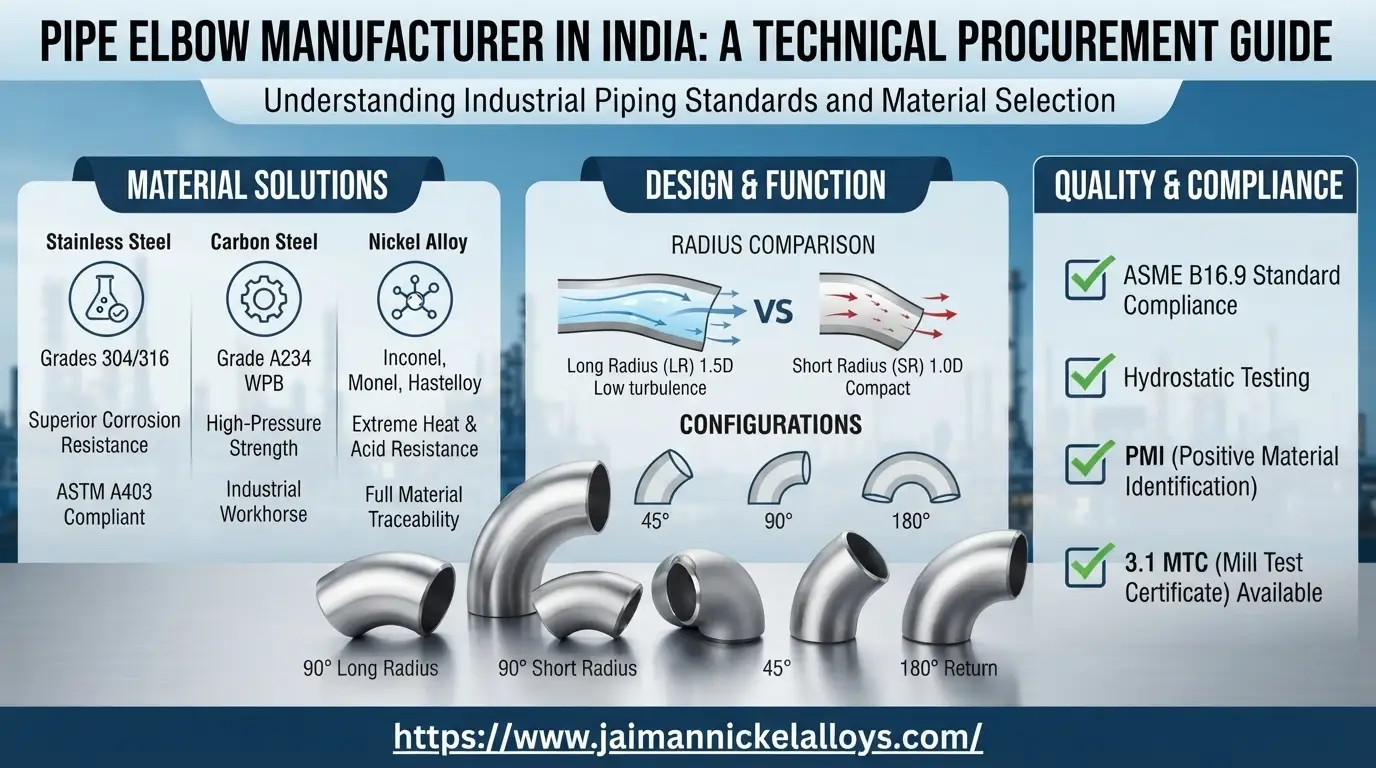
Stainless steel pipe elbows are essential fittings used to change the direction of flow in a piping system. Because they are exposed to the same pressure and environmental stresses as the pipes themselves, they must be manufactured to withstand specific thermal and corrosive conditions without compromising the structural integrity of the line. They are a key component of any buttweld pipe fitting system.
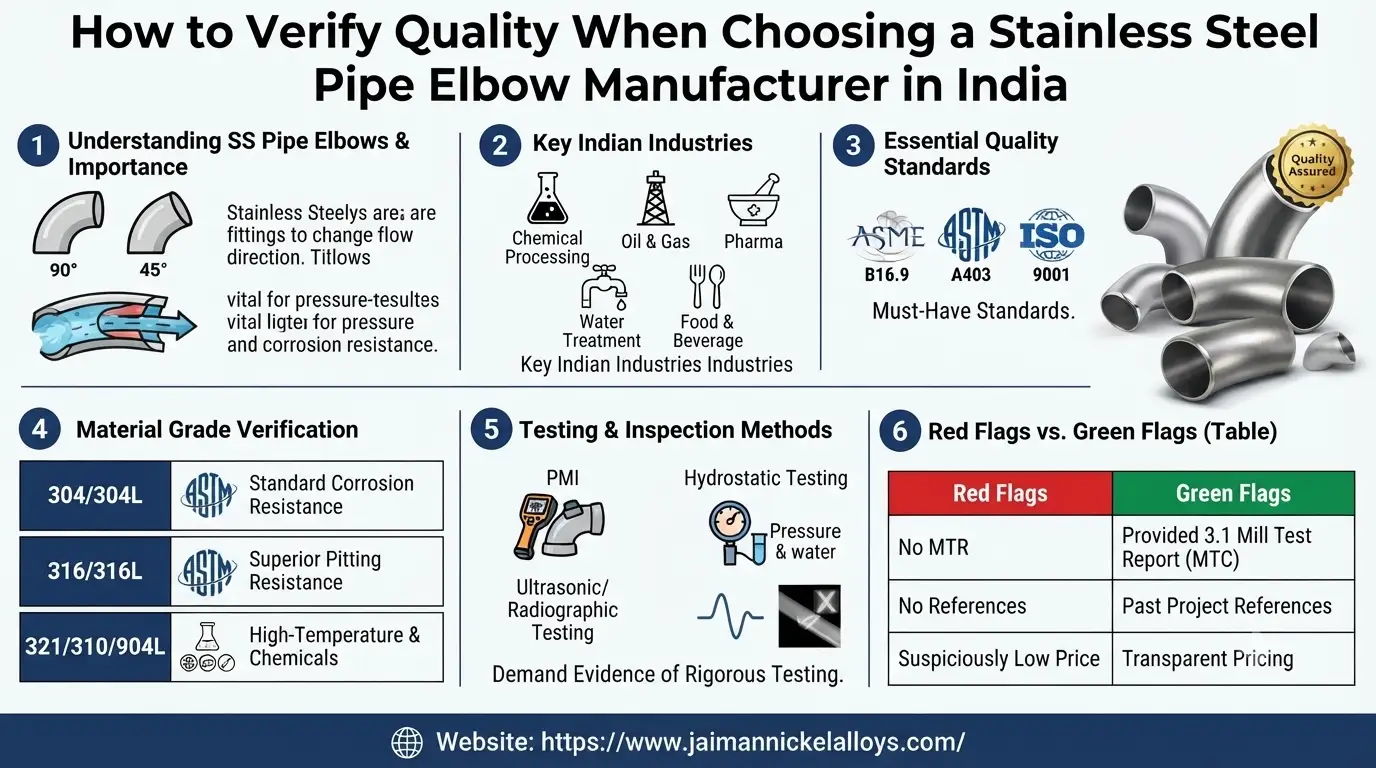
High-performance stainless steel fittings are vital for India's booming industrial sectors, including chemical processing, oil and gas, pharmaceuticals, food and beverage, and water treatment. These industries also rely on flanges, pipe tees, and pipe reducers for complete piping assemblies. In these environments, even minor material impurities can lead to premature failure.
Low-quality manufacturing often results in fittings with inconsistent wall thickness, poor welding integrity, or incorrect material grades. These defects can lead to premature corrosion, pressure-induced bursts, and the high cost of emergency shutdowns.
Established Indian manufacturers prioritize compliance and traceability. Partnering with a reputable source guarantees that your components have undergone standardized production, ensuring compatibility with your existing piping schedule and reducing long-term maintenance needs.
While low-grade fittings may seem cheaper initially, the cost of a single failure—including lost production and replacement parts—far exceeds the initial savings. Quality-assured fittings are a long-term investment in plant safety and operational continuity.
Never accept fittings that do not meet global benchmarks. The most critical standard for buttwelding fittings is ASME B16.9. Additionally, your manufacturer should conform to ASTM A403, which governs the specific requirements for wrought austenitic stainless steel piping fittings.
Look for ISO 9001 certification to ensure consistent management systems. Furthermore, check if the manufacturer holds certifications relevant to your specific industry, such as PED (Pressure Equipment Directive) for European exports or IBR (Indian Boiler Regulations) for steam piping projects in India. Visit our quality assurance page to see our certifications.
Stainless steel is not a one-size-fits-all solution. Ensure the manufacturer provides verified documentation for grades like:
If possible, visit the facility. Inspect the raw material storage (ensuring different grades are not mixed), the cleanliness of the production floor, and the organization of the quality control laboratory. A professional factory is a transparent one.
Observe the forming process. Whether the elbows are seamless or welded, the manufacturer must use properly calibrated dies. Surface finishing, such as pickling and passivation, is essential to restore the protective chromium-oxide layer after heat treatment.
Do not settle for visual inspection alone. Demand evidence of:
| Feature | Red Flags (Avoid) | Green Flags (Choose) |
|---|---|---|
| Documentation | No MTR or vague certificates | Provided 3.1 Mill Test Reports (MTC) |
| Pricing | Significantly lower than market rates | Competitive but transparent pricing |
| Standards | "Generic" or "Standard" labels | Explicit ASME/ASTM compliance |
| Technical Support | Reluctant to answer technical queries | Offers engineering/custom design support |
Pro Tip: Always ask — "Can you provide a 3.1 Mill Test Certificate for this specific heat number?" and "Are your products fully compliant with ASME B16.9?" before placing any order.
The following table outlines standard dimensions for stainless steel pipe elbows commonly utilized in industrial piping systems:
| Nominal Pipe Size (NPS) | Outside Diameter (mm) | 90° Long Radius | 45° Long Radius |
|---|---|---|---|
| 1/2" | 21.3 | 38 mm | 16 mm |
| 3/4" | 26.7 | 38 mm | 19 mm |
| 1" | 33.4 | 38 mm | 22 mm |
| 1-1/4" | 42.2 | 48 mm | 25 mm |
| 1-1/2" | 48.3 | 57 mm | 29 mm |
| 2" | 60.3 | 76 mm | 35 mm |
| 2-1/2" | 73.0 | 95 mm | 44 mm |
| 3" | 88.9 | 114 mm | 51 mm |
At Jaiman Metalloys, we bridge the gap between technical excellence and reliable supply. We specialize in providing high-grade stainless steel pipe elbows that are rigorously tested to meet ASTM and ASME standards, ensuring your project operates with maximum uptime and safety. We also supply pipes and tubes, forged fittings, and sheets, plates & coils for complete industrial solutions.
Selecting the right partner is more than a procurement task; it is a proactive measure to prevent future operational failures. By prioritizing rigorous material certification, strict adherence to international standards, and transparent quality testing, you secure the long-term integrity of your entire piping system.
Ready to start your project with quality-assured components? Contact our technical team today to request a quotation. For more information, visit our comprehensive Pipe Elbow Manufacturer in India pillar page or read our related blog on pipe elbow technical procurement guide.