We are a trusted supplier of high-quality aluminium and metal products, offering precision-manufactured materials, consistent quality, and dependable delivery for industrial, engineering, and fabrication needs.
Jaiman Metalloys LLP
We are a trusted supplier of high-quality aluminium and metal products, offering precision-manufactured materials, consistent quality, and dependable delivery for industrial, engineering, and fabrication needs.
Selecting the right pipe elbow manufacturer in India is a critical decision for the integrity of your industrial piping system. Whether you require standard carbon steel fittings or specialized nickel alloy elbows, your choice directly impacts system pressure ratings, corrosion resistance, and total cost of ownership. This guide evaluates material grades, international standards, and the quality testing protocols necessary to ensure your pipe elbow fittings operate safely and efficiently under extreme conditions.
A pipe elbow is a crucial fitting installed between two lengths of pipe to facilitate a change in the direction of flow. In industrial applications, the design of the elbow is dictated by the specific fluid characteristics and the space available within the piping layout. It is one of the most commonly used components in buttweld pipe fittings alongside pipe tees, pipe reducers, and pipe end caps.
The primary role of an elbow is to redirect flow while maintaining the structural integrity of the piping line. Proper design prevents unnecessary turbulence and pressure drops, which are critical in high-velocity fluid systems.
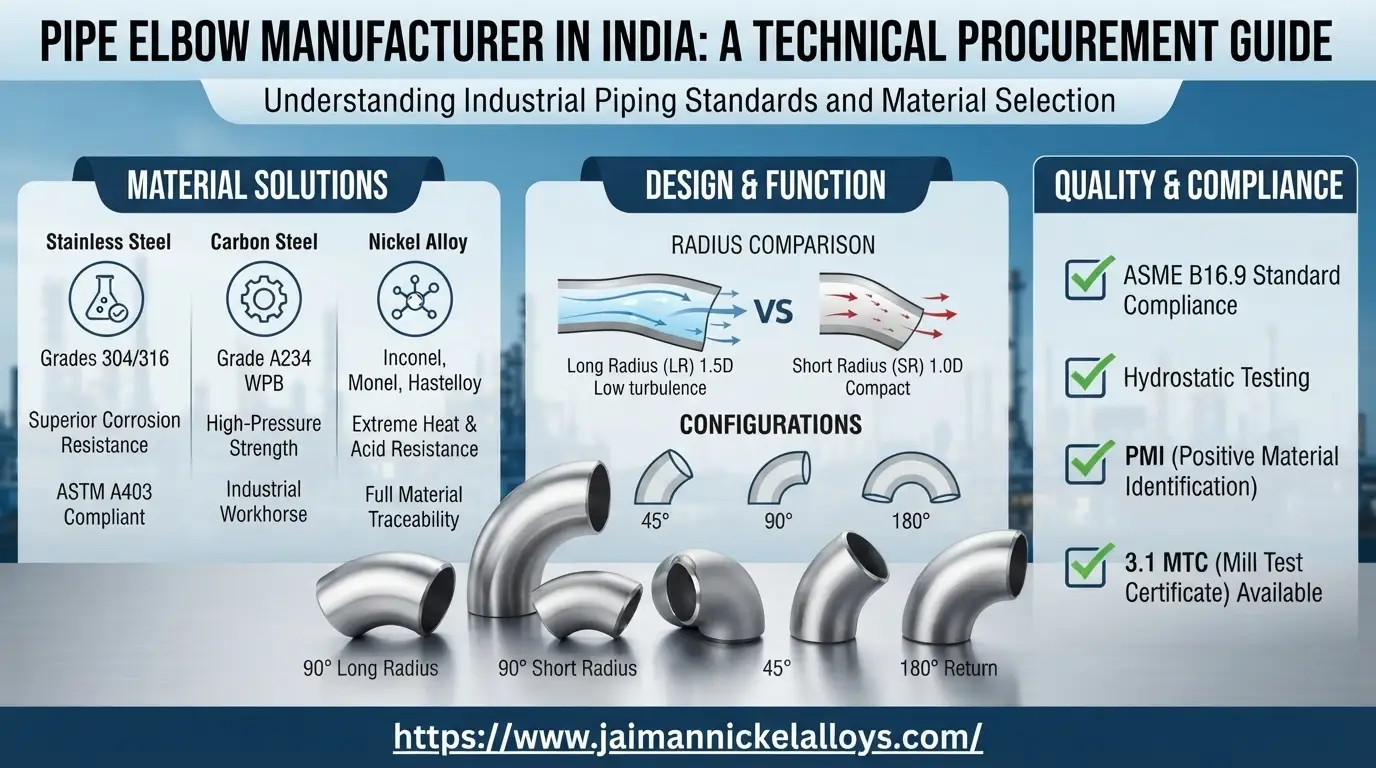
The choice of radius significantly affects system performance and space requirements. Long radius (LR) elbows are preferred to reduce friction, while short radius (SR) versions are utilized in tight, space-constrained environments.
| Feature | Long Radius (LR) | Short Radius (SR) |
|---|---|---|
| Radius | 1.5 x Nominal Pipe Size | 1.0 x Nominal Pipe Size |
| Pressure Drop | Minimal | Significant |
| Use Case | General Piping | Compact/Tight Spaces |
Elbows are commonly manufactured in 45-degree and 90-degree configurations to suit standard pipe routes. For specific systems like heating coils or return bends, 180-degree elbows are utilized to reverse flow direction effectively. These are often used alongside pipe bends and pipe cross fittings in complex piping layouts.
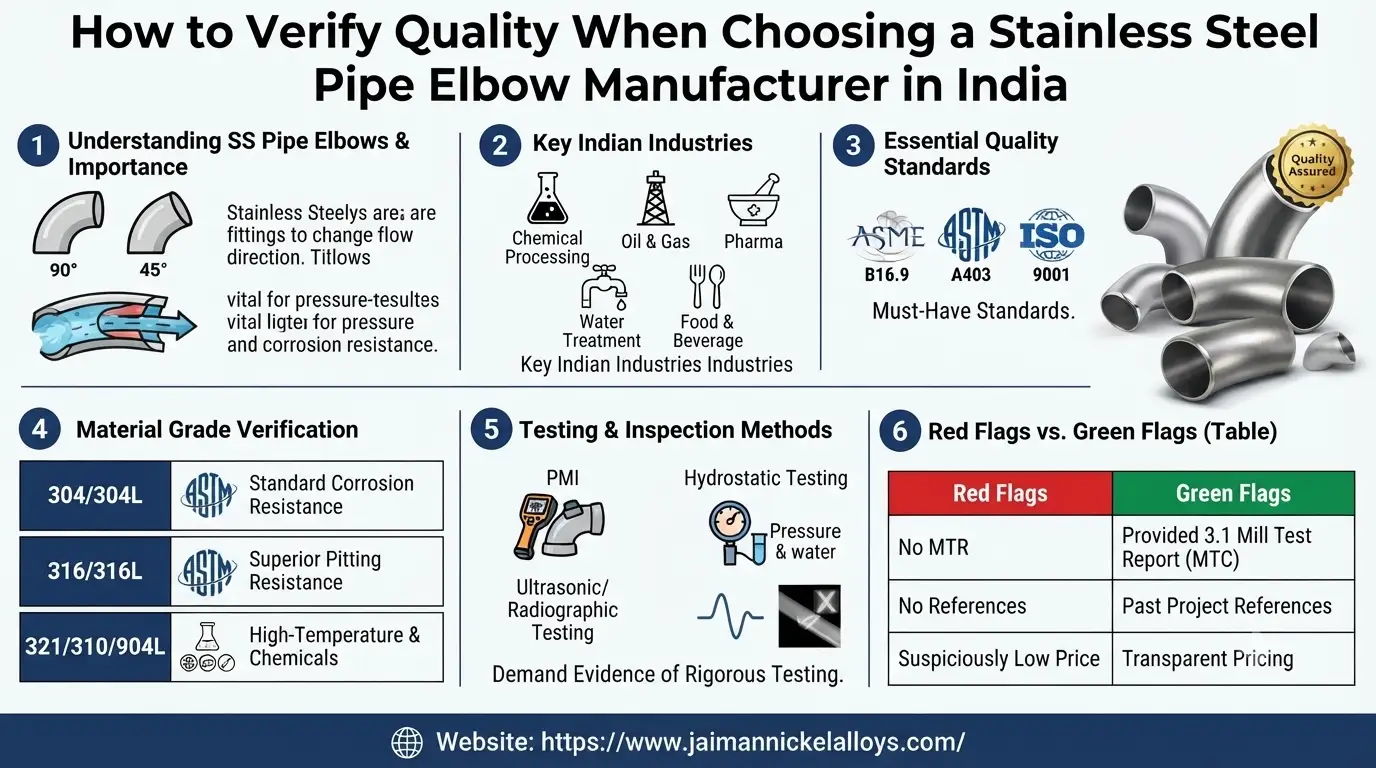
When dealing with corrosive environments, material selection is the primary safeguard against system failure. As a leading Stainless Steel Pipe Elbow Manufacturer in India, we emphasize the importance of selecting the correct grade based on the chemical composition of the fluid being transported.
Grade 304/304L is chosen for general-purpose applications due to its cost-effectiveness. However, for marine or chemical processing, Grade 316/316L is the industry standard due to its molybdenum content, which resists pitting.
All stainless steel fittings must strictly adhere to ASTM A403 standards. This ensures that the chemical composition and mechanical properties are consistent across batches, providing the reliability required for industrial safety.
The longevity of a piping system depends on the material's ability to resist degradation. Stabilized grades like 321 are often required in high-temperature settings to prevent intergranular corrosion. Explore our full range of stainless steel pipe elbows on our product page.
In sectors like oil and gas, power generation, and refining, systems often operate under extreme pressure and temperature. Carbon and alloy steel are the materials of choice here, as they provide the mechanical strength and thermal stability required to prevent rupture or deformation. These are often paired with pipe reducers, flanges, and forged fittings in high-pressure assemblies.
Carbon steel, specifically ASTM A234 WPB, serves as the standard for most infrastructure piping. It offers a perfect balance of excellent weldability and high yield strength, making it ideal for standard oil and gas transport.
For more extreme conditions, alloy steels like WP5, WP9, or WP11 are utilized. These are engineered to maintain their structural integrity and load-bearing capacity even during intense thermal fluctuations in refineries.
As a specialized Carbon Alloy Steel Pipe Elbow Manufacturer in India, we ensure that each fitting is processed to meet the rigorous thermal and mechanical demands of high-pressure service, following strict ASTM A234 specifications. Review full specs on our Carbon Alloy Steel Pipe Elbow product page.
Nickel alloys represent the peak of material science in industrial piping. When your project faces aggressive chemical media, cryogenic temperatures, or extreme heat, standard steels will likely fail.
Alloys such as Inconel, Monel, and Hastelloy are designed to withstand harsh conditions without degradation. Monel is particularly effective in saltwater applications, while Hastelloy provides unmatched protection against severe chemical acids.
Because these materials are used in critical infrastructure, we maintain complete material traceability. As a Nickel Alloy Pipe Elbow Manufacturer in India, we ensure that every elbow is documented from its raw heat number through the final heat treatment process.
These alloys are valued for their oxidation resistance and ability to maintain strength in extreme heat. They are the preferred choice for aerospace, chemical processing, and power plants where component failure is not an option. Learn more on our Nickel Alloy Pipe Elbow product page. You may also explore our nickel alloy pipes and tubes and pipe nipples for complete system solutions.
Selecting a manufacturer involves more than comparing quotes; it requires an audit of their quality assurance capabilities. A reliable partner will provide comprehensive documentation that verifies the integrity of the product before it arrives at your site.
Key Tip: Always request a 3.1 Mill Test Certificate (MTC) as per EN 10204 before finalizing any order. This document is your primary proof of quality and compliance.
This is the global benchmark for wrought buttwelding fittings. Adherence to ASME B16.9 ensures that your elbows will match the dimensions, pressure ratings, and wall thickness of your piping system without risk of joint failure.
To ensure safety, a manufacturer must perform standardized tests. These include Positive Material Identification (PMI) to verify chemical composition, as well as hydrostatic and radiographic examinations to detect internal defects.
A 3.1 Mill Test Certificate (MTC) as per EN 10204 is the essential proof of quality. It provides the necessary verification that your products meet the specified ASTM or ASME standards. Request a quote from our team today. Also check our quality assurance page and our range of sheets, plates & coils for complete material solutions.
Selecting the right partner is more than a procurement task; it is a proactive measure to prevent future operational failures. By prioritizing rigorous material certification, strict adherence to international standards, and transparent quality testing, you secure the long-term integrity of your entire piping system.
Ready to start your project with quality-assured components? Contact our technical team today to request a quotation. For more information, visit our Pipe Elbow Manufacturer in India product page or read our related blog on how to verify stainless steel pipe elbow manufacturer quality.